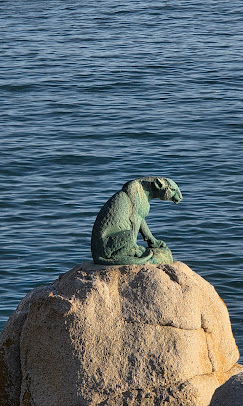

The beautiful bronze leopard of Hout Bay was sculptured by Ivan Mitford-Barberton, who, after creating it, donated it to the Hout Bay community. Completed in 1963, weighing in at 295 kgs, the statue was placed on its rocky pedestal on the 14th of March 1963 by the Divisional Council. The project was supported by Pepsi-Cola who donated the bronze for the statue. Although many may have spotted it before, some might be wondering what this beautiful lone sculpture signifies – The bronze leopard sculpture is a memorial dedicated to all the wild animals that once called the area home and freely roamed the mountains of the peninsula.
The Cape Peninsula was once home to an abundance of wildlife that freely roamed its natural landscapes and mountainsides. As Cape Town became more and more populated and developed, the population of Cape wildlife progressively diminished. This eventually led to nature receding, and the Cape’s magnificent wild animals, that once roamed free, migrating to less populated environments to establish a new natural habitat for themselves free from human interference. This completely changed Cape Town’s natural landscapes. According to the Hout Bay Museum, the last leopard spotted in Hout Bay was seen on Little Lion’s Head in 1937.
Locals and tourists visiting Cape Town have the incredible opportunity to spot the last leopard of Hout Bay by taking a drive along one of the most magnificent coastal drives in the world, Chapman’s Peak Drive. As a symbolic reminder, the famed bronze leopard’s gaze overlooks the mountainside where it’s kind once roamed free and will forever live on in history as the only leopard left in Hout Bay.
Many people who pay this beloved Hout Bay landmark a visit will notice that its colour appears more blue than bronze. Over the years, the bronze colour has turned blue because of the oxidation of bronze in the salty breeze of Hout Bay.
WHERE ARE THE CAPE LEOPARDS NOW?
The Cape leopards stick to the more remote and rocky hilltops and less populated mountainous regions of the Western Cape. They thus steer clear of the inhabited valleys and populated natural landscapes of the Cape – further reducing chance encounters with these felines.
Beside the aforementioned locations, the Cederberg region in the Western Cape is one of the main pockets where Cape leopards are still found, with only about 35 adults left. That puts the numbers at about one leopard per 120km² over an area of about 3000km². Through the great work and incredible tracking efforts of the Cape Leopard Trust, over 50 Cape leopards have also been recorded in the Boland Mountains, in a core area of 3000km² consisting of nature reserves, game farms and private land.
Another incredible organisation, The Landmark Foundation, which is aimed at conserving leopards of the Cape by working with various landowners, farmers and nature reserves has done some remarkable work in the conservation of these magnificent wild animals. The Landmark Foundation has responded to cases where leopards need to be rescued, rehabilitated, and released, as well as researching leopards found on private land (farms and wilderness areas).
The Landmark Foundation’s projects show that a few leopards are still to be found in the Cape Winelands and Overberg region of the Western Cape. They have also recorder the presence of leopards in the Outeniqua Mountains on the Garden Route as well as the Zuurberg Mountains in the Eastern Cape and in parts of the Karoo. Lone leopards have been spotted from time to time in unlikely places like on Wine Farms in Somerset West and on the Cape West Coast.
WHAT IS BEING DONE TO CONSERVE THE CAPE LEOPARDS?

Both the Cape Leopard Trust and the Landmark Foundation work with farmers to find sustainable solutions that address livestock loses through predation by leopards and other wild predators. Getting private landowners on board, shifting attitudes, and changing responses to locally occurring leopards are key factors in saving the remaining leopards. Both the leopard trust and non-profit organisation are involved in leopard research, collaring and tracking leopards as part of their efforts to understand and manage leopard populations. Secret Cape Town